
Hp 5342a & the 1826-0372
HP 5342A Repair Log — Restoring the High Frequency IF Path (1826-0372 Replacement)
- Instrument & Failure Description
Instrument: HP 5342A Microwave Frequency Counter Frequency Range: 0–18 GHz Unit age: ~1980’s
Observed failure:
- Direct count (low band) still worked
- High frequency path (>500 MHz) intermittent
- Unit could operate for ~1 hour, then fail
- After failure, sensitivity dropped to zero on high band
- IF output from A25 IF/driver board disappeared
- No overload (OVL) indicator, no counting on high band
Classic symptom cluster → IF path failure, not sampler or prescaler.
- Initial Diagnosis
Key findings during troubleshooting:
✔ IF present after sampler (A26)
✔ IF present into U1 (1826-0372 limiter #1)
✔ IF present out of U1 (≈ 300–400 mV @ test)
✔ No IF into U2 output (same device type 1826-0372)
✔ U2 output stuck at ~3.7 V DC, no IF
✔ U2 pin 5 & 7 bias values correlating to “failed limiter”
Conclusion: U2 hybrid (1826-0372) was dead, U1 was still healthy.
This is consistent with known field failures: on 5342A, U2 runs hotter and drives the IF output to A11.
- Thermal/Intermittent Behavior
Notable behavior:
- When cold → sometimes works
- After ~1 hour → U2 quits
- Letting unit cool → recovers temporarily
Indicates classic hybrid thermal degradation (bond wire / die attach / metallization deterioration).
- Known Issues with 1826-0372
Searching HP groups.io and service reports confirmed:
- 1826-0372 failures are common
- Most failures are on U2, rarely U1
- NOS replacements are unreliable due to age
- Verification Measurements Before Repair
Before U2 death (when it managed to run 1 hour), unit sensitivity was:
- 19 GHz @ –20 dBm — exceptionally good
This confirms:
- Sampler on A26 healthy
- U1 healthy
- Prescaler healthy
- A11/OVL healthy
- Timebase OK
- Repair Approach Options
Option A — NOS hybrid replacement
Pros: drop-in
Cons: NOS degraded, expensive, unobtainium, sometimes dead-on-arrival
Option B — Rebuild U2 using discrete components
Pros: new silicon, thermally stable, repeatable
Cons: requires RF knowledge, hand-tuning
Chosen solution: Option B
- Custom U2 Replacement Implementation
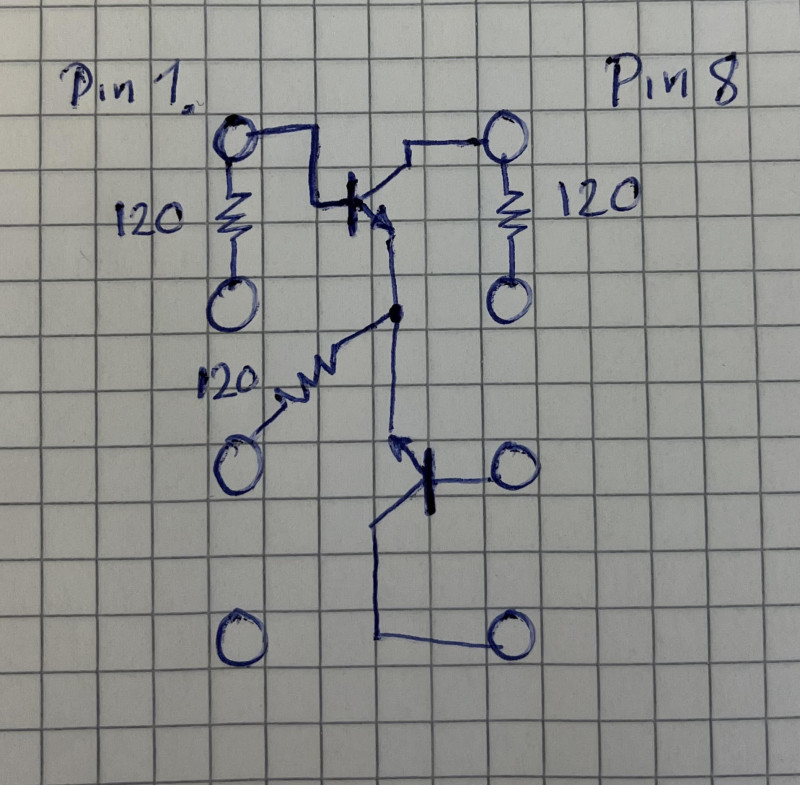
Discrete U2 built according to my ugly hand-drawn schematic:
- 2× BFR93 RF transistors
- 3× 120 Ω resistors (bias + limiter shaping)
Functionally equivalent to:
- limiter stage
- IF driver
- bias/threshold
Soldered into position of removed U2 hybrid. I recommend to cut the old 0372 instead of try to de-solder it. This because old FR-4 can be quite brittle. But do what you think is best.
Schematic of the hybrid:
- BAL Adjustment
BAL trimmer controls:
- limiter symmetry
- IF clipping level
- OVL threshold
- high-band sensitivity
With custom U2 installed:
✔ limiter waveform adjustable
✔ clean clipping achieved
✔ no DC offset anomalies
✔ no oscillation
- Waveform Verification
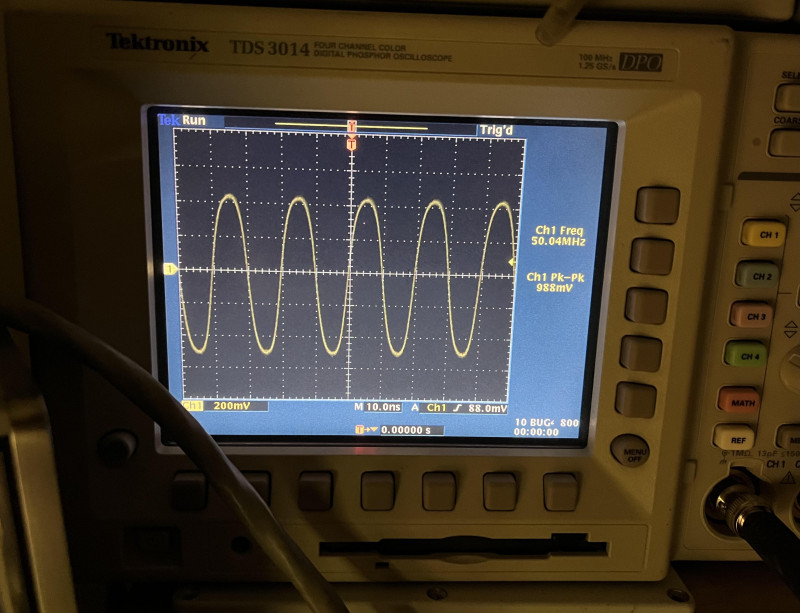
Test signal: 50 MHz into RF input Observed on IF:
- clean sine-to-limiter shape
- ~1 V p-p
- symmetric clipping
- correct bias point
50 MHz works because direct-count path feeds limiters without sampler, making it ideal for BAL tuning.
- Sensitivity After Repair
Measured with HP generators & power meters:
|
Band |
Measured sensitivity |
|
10 GHz |
–33 dBm |
|
18–20 GHz |
–24 dBm |
These values are better than HP factory spec (typ. –20 dBm at 18 GHz).
- Thermal Stability After Repair
Long-run test:
- 8 hours warm
- No sensitivity loss
- No IF dropout
- No OVL malfunction
Confirms custom U2 solution is thermally superior to aging hybrid.
- Conclusion
The high-band failure of the HP 5342A was caused by a dead 1826-0372 IF/driver hybrid (U2) on A25 board.
Replacing U2 with a discrete design restored:
✔ high-band sensitivity
✔ limiter function
✔ OVL behavior
✔ long-term stability
Performance now exceeds original HP specification.
- Notes for Other Owners
- If direct count works but high band dies → suspect U2
- If high band works cold but fails hot → suspect U2
- U1 rarely fails but U2 often does
- NOS hybrids are hit-or-miss due to aging
- Discrete replacement is viable & robust
But of course, sometimes it is the sampler that has a failure. A measurement at the A25 inlet from the sampler with a scope will tell if there is the high and low side from the sampler. Then out from the first BFR-90 amp => second BFR-amp and so on. There were more problems except the 1826-0372 present. I replaced 8 electrolytic capacitors on various places. One trimpot had a problem at the oscillator. Extra soldering was needed at the A25 pre-amp board. But actually, if I have replaced the 0372 first maybe that would fix it?
The 0372 was standard in IF chains from 1978 to 1990. As in instruments:
HP 5342A, HP 5343A, HP 5345A (not exact but works), HP 5370A/B (depends on REV, but works), HP 5350/5351/5352-series (B/C uses 0372), HP 8440/8441 Sampler front-end, HP 8566/8568 spectrum analyzers, HP 8620/8660/8662/8663 generators (not as limiter, input protection & sampler gates)
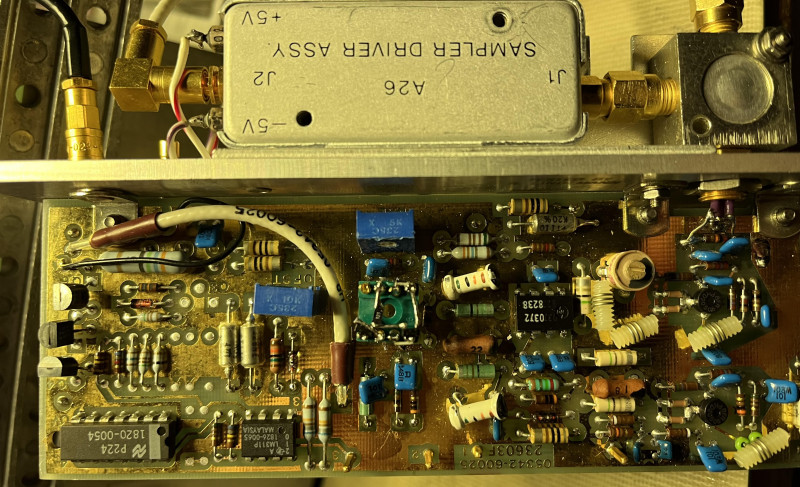
New hybrid can be seen in the middle (U2).
Welcome
Welcome to sm6why.n.nu.

My Newsletter
Links